Introduction to Aloe ‘Lode’s Yellow’
This is the story of the illusive, endangered, and mysterious hybrid we call Aloe ‘Lode’s Yellow’. From mysterious origins to an international search, and now a risk of extinction. Learn all about my journey uncovering the origins of this illusive aloe!
What is Aloe ‘Lode’s Yellow’?
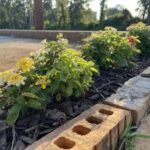
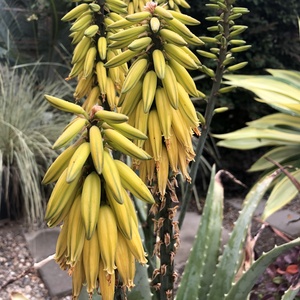
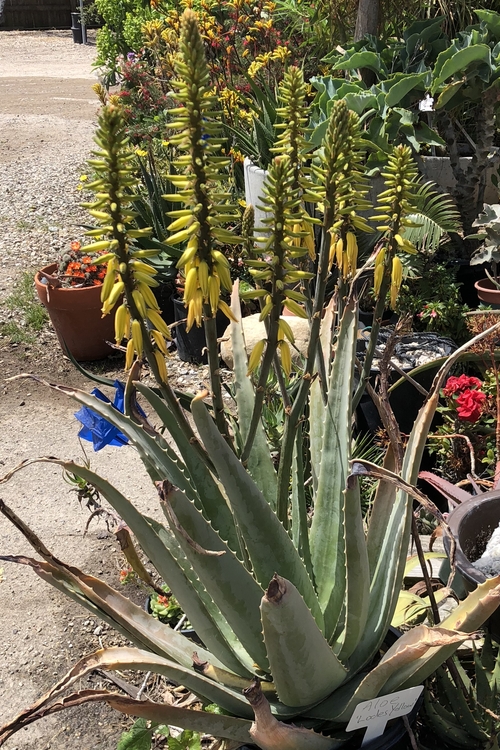
At first glance, this plant could fool you into thinking it is a common Aloe vera due to its bright yellow flowers, but the leaves grow long and slender, edged with gentle teeth, and coated in a grey powder, which is unlike Aloe vera‘s thick, green, sturdy leaves.
In the garden, this difference is striking. Aloe ‘Lode’s Yellow’ combines the beauty and familiarity of Aloe vera, with the hardiness and wild growth of Aloe koenenii. It thrives in dry, sunny conditions, tolerates drought well, and produces blooms that feel unusual and awe-inspiring. For hobbyists, this hybrid is a lower maintenance version of a classic garden staple, and for collectors, it is a plant with a story rooted much deeper.
The Discovery of Aloe ‘Lode’s Yellow’
I first discovered this plant while looking to identify a yellow-flowering aloe that I was given in the fall of 2023. I stumbled upon the only online listing for this plant at the time, which was found at San Marcos Growers—a wholesale nursery in California. I was struck by how familiar and unfamiliar it looked at the same time. The yellow flowers resembled Aloe vera, a plant almost everyone recognizes; however, the greyish-powdery leaves took the form of Aloe koenenii, a a taxon found in cultivation around Petra, Jordan. Combined, the two traits created something unique: a plant that could easily be mistaken for A. koenenii at first glance, until the golden blooms opened and revealed its mystery.
A Plant Without a Past
According to San Marcos Growers, the plant was first documented in the United States growing in a Santa Barbara garden, but it was not yet known to be a hybrid; rather, it was grown by plantsman Tim Harvey from seed labeled Aloe porphyrostachys ssp. koenenii. That seed came from French researcher and explorer, Joël Lodé. The seed was grown out under the assumption that it was A. koenenii, until the flowers bloomed and told another story. A. koenenii should bloom red or orange, but this plant was unmistakably blooming a bright yellow. After this mystery, Tim Harvey gifted the aloe to San Marcos Growers to begin cultivation.
Following the Trail Back to Joël Lodé
Curiosity struck when I noticed that, despite San Marcos Growers having grown this variety for years, they listed the parentage as unknown! This mysterious hybrid had no known father, so I dug into Joël Lodé’s background for clues. Based off information found on his website, online forums, and blog posts, I learned that he has been collecting and cultivating rare aloes across the world for decades. He cultivates numerous Aloe species and collections together at his Canary Islands facilities. In his facility, he relies heavily on open pollination from the native insects, which means that, if A. koenenii was grown at this facility during the time when Tim Harvey’s seed was collected, the yellow flowers made any yellow flowering aloe grown at this facility a particularly plausible pollen parent. After further research, I discovered that the most widely grown aloe species at this facility during the time was A. vera, but I still did not have proof that Joël Lodé had grown A. koenenii at this facility.
A Theory of Hybrid Origins
I reached out to Mr. Lodé directly with the hope of sharing my theory, and to my surprise, he confirmed that he did indeed grow A. koenenii alongside A. vera during the timeframe that the hybrid seed was collected, although the actual location of the cross was potentially in Spain; furthermore, he informed me that he also suspected ‘Lode’s Yellow’ to be the result of A. vera and A. koenenii crossing naturally. He had never intentionally made the cross; in fact, he never even knew of the hybrid’s existance until a San Marcos Growers employee, Randy Baldwin, contacted him a few months before I did.
Lodé even shared with me some unpublished notes on his decades-long struggle to work with A. koenenii, as well as some backstory to the accidental origin of ‘Lode’s Yellow’ These records, written in his own words, provide a rare glimpse into the challenges of aloe pollination.
Joël Lodé’s Notes on Aloe ‘Lode’s Yellow’
Mr. Joël Lodé sent me these notes in 2024 and authorized me to share them. The original document was written in poor English, so I edited some grammar, but I believe that I kept the original message.
“In the eighties, I wished to discover the origin of Aloe vera, so I travelled the world to collect cultivated specimens of the species, and I visited locations which may have this species.
In 1985, soon after I began my travels, I discovered Aloe porpyrostachys ssp. koenenii (Lavranos & K. Koch) J. Lodé (syn. Aloe koenenii Lavranos & Koch) in Petra, Jordan. Because this species does not produce offsets easily or quickly, my aim was to achieve a successful pollination between clones whenever my different clones would flower.
I remembered that in 1995 while working on seed production at “Canary Cactus”. After bringing many Aloe vera plants from different parts of the world (including South America) to the Canary Islands, they were all mixed in our open production of Aloe vera, and we were helped by bees to produce the first fruit and seeds.
The flowering of Aloe porpyrostachys ssp. Koenenii finally happened after 12 years of cultivation in the Canary Islands, but it never produced any seeds, so I concluded that the plants were sterile. I did not intend to use Aloe vera for cross-pollination, as I do not like to make hybrids. Also, during this time, I cannot remember any insect activity around the flowers.
However, in 2000, after moving to Spain, mainland, in Andalucia, I tried every year to pollinate them, and in order to increase the number of flowers, I propagated them vegetatively from the few offsets appearing at the very base of the plants. They were very difficult to separate, unlike that of Aloe vera, which are numerous and very easy to separate.
Finally, in 2010, after many hand pollinating attempts in the morning, and also in the afternoon, very few fruits appeared in some of the stalks, and I was able to collect the first seeds, which were sown, and proved to be viable. I gave the first seedlings available to the collectors.
In the decades I have been growing Aloes, I have noted that very few species are able to produce seeds from self-pollination, (e.g. in Aloe niehburiana), while most other species cannot (e.g. Aloe trichosantha, fleurentinorum). Some plants, like my three Aloe sabaea produce seed some years, and do not some other years, even when they have all been hand pollinated. Some specimens within a species seems to be more fertile than others. Although we have much experience with Aloes over decades of cultivation, they still have still some secrets in their fruiting behaviour.” – Joël Lodé
These notes highlight just how unlikely it was for A. koenenii to produce seed at all, and why the hybridization with A. vera could have happened only under very specific circumstances.
Flaws of Aloe ‘Lode’s Yellow’
In my brief conversation with Randy Baldwin of San Marcos Growers, Mr. Baldwin shared with me one flaw he noticed with the hybrid. He mentioned that the hybrid has a tendency to turn an unappealing grey color during the cold, humid months of a California winter. For this reason, San Marcos Growers stopped propagation of the variety some time before their final closure in December 2025.
Sidebar: The Mother Plant – Aloe koenenii
Discovered in 1985 by Joël Lodé during his travels to Petra, Jordan, Aloe koenenii is a species as remarkable as the ancient city where it grows. Petra, famous for its rock-cut architecture and desert setting, provides the rocky slopes that shelter this aloe. Unlike the common A. vera, koenenii is slow-growing, reluctant to offset, and stubborn about flowering. Its inflorescences (flowers) carry red or orange blooms.
Aloe koenenii is undoubtably the mother of Aloe ‘Lode’s Yellow, as the original specimen found in the Santa Barbera Garden by Tim Harvey was grown from seed collected from the fruit of an Aloe koenenii by Joël Lodé.
Aloe koenenii was officially described in 2006 by John Lavranos and Kerstin Koch, with its name honoring German horticulturist Manfred Koenen, who collected the type specimen. In cultivation; however, Joël Lodé may have actually been the first to discover this subspecies. Joël Lodé proposes the name “Aloe porpyrostachys ssp. koenenii (Lavranos & K. Koch) J. Lodé” for this subspecies as a compromise for both parties receive credit.
The Story Behind the Name ‘Lode’s Yellow’
Naming the plant after Joël Lodé is fitting. Aloe ‘Lode’s Yellow’ is not the product of a breeding program or deliberate experiment. Instead, it reflects his lifelong work with aloes, his willingness to cultivate difficult species, and the unpredictable role of pollinators in the garden. Despite Mr. Lodé’s disinterest in creating hybrids, the accidental origins of this variety were made possible by what Mr. Lodé stood for in the collection, doccumentation, and preservation of wild species.
Aloe ‘Lode’s Yellow’ at Risk of Extinction
Sadly, the future for Aloe ‘Lode’s Yellow’ is uncertain. San Marcos Growers, the only known nursery to have produced this variety commercially, has officially closed all operation and their land has been rezoned. Without their propagation efforts, ‘Lode’s Yellow’ risks slipping back into obscurity, potentially lost to cultivation altogether.
Some individuals online claim to grow this variety, but thus far, most sources trace back to Dry Oasis Plants, which currently shows it to be out of stock, and to date, has never responded to any form of contact from me regarding their source for the variety. There is hope, because there is now strong evidence that ‘Lode’s Yellow’ still exists, including a 2022 landscape planting schedule specifying three 15-gallon plants in Tiburon, California. There is no true way to know how many specimens remain… if any remain at all.
Known Sources of Aloe ‘Lode’s Yellow’
Here is a list of all major mentions that I have found for the hybrid, disregarding the false identifications which I have ruled out:
Dry Oasis Plants — Plant Grower Company
Bidscape — Wholesale Plant Supply Company
San Marcos Growers — Wholesale Plant Grower Company
Gardener’s Basic Seed Supply — (Sourcing from Dry Oasis Plants)
Town of Tiburon Hillside Design Project — 2025
Thousand Oaks Civic Arts Plaza Redevelopment — 2022 California Landscaping Project
Santa Clara Valley Water District Qualified Plants List — List of Plants Grown in Santa Clara Valley
A Call to Preserve Aloe ‘Lode’s Yellow’
That is why this plant deserves more attention from collectors and succulent enthusiasts. Aloe ‘Lode’s Yellow’ is more than just another aloe. It carries with it decades of history, cultivation, and research. This hybrid is a unique blending of species, and more importantly, a living story that may never occur again.
If you are fortunate enough to find one, I encourage you to grow it, propagate it, and share it with others. Its survival now depends not on nurseries, but on gardeners who recognize the value of preserving living history. By keeping Aloe ‘Lode’s Yellow’ in cultivation, we ensure that its story continues, not as a forgotten footnote, but as a testament to the patience of growers and the mysteries of nature.
If you know anything about this variety, or have a specimen to share, please reach out at +1 (936) 800-7350, or info@gen1greenhouse. The survival of this hybrid relies on us. I will do all I can to help, but I cannot do it alone. I need your help!