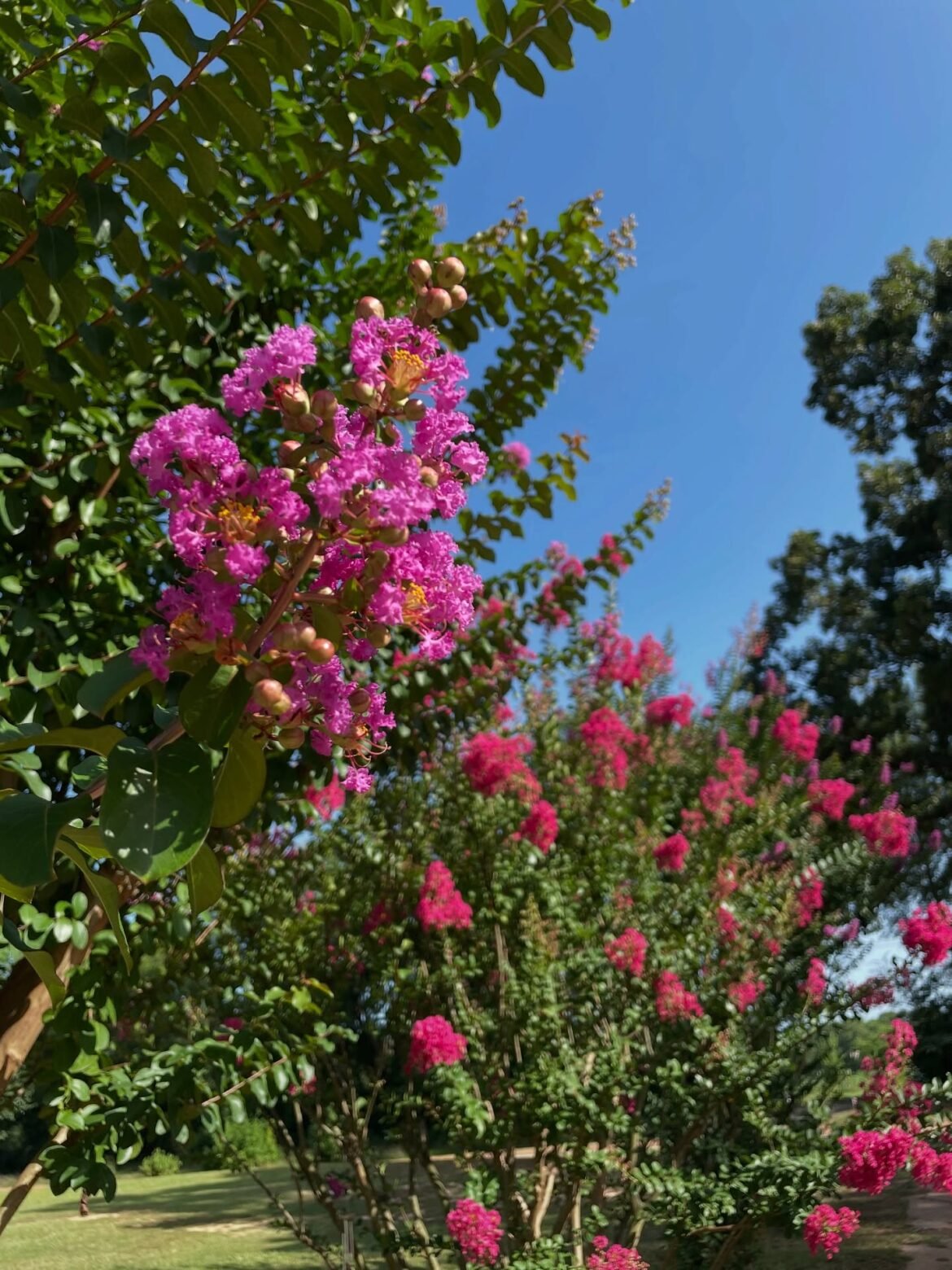
Crepe myrtles are among the most recognizable flowering trees in the South. They are valued for their summer flowers, attractive bark, fall color, and relatively low maintenance requirements. Unfortunately, they are also among the most frequently mistreated landscape plants.
A properly planted crepe myrtle often requires little pruning. The goal of pruning should not simply be to make the tree smaller or force it into a particular shape. Instead, pruning should be used to develop a strong structure, remove damaged or poorly positioned growth, improve clearance, and maintain the natural form of the plant.
This guide explains when to prune crepe myrtles, how to make proper cuts, which pruning methods are appropriate, and why topping (or “crepe murder”) should generally be avoided.
Simplified Crepe Myrtle Pruning Guide
If you only remember a few things about pruning your crepe myrtle, remember these:
When: Late winter, while the tree is dormant and before new growth begins, is generally the best time for structural pruning.
What to remove: Remove dead, damaged, diseased, crossing, rubbing, or poorly positioned branches. Remove unwanted suckers growing from the base or roots.
How much: Prune selectively rather than removing large portions of the canopy. A healthy, properly located crepe myrtle may need very little pruning.
Flowers: Crepe myrtles bloom on new growth, so necessary structural pruning in late winter will not prevent summer flowering. Removing spent flower clusters during summer can sometimes encourage additional flowering, although this is not necessary for many modern cultivars.
Height: Do not routinely cut the entire top of the tree back to the same height. If a crepe myrtle is consistently too large for its location, replacing it with a cultivar that reaches an appropriate mature size is often a better long-term solution.
Never top it: Do not cut the major branches back to large stubs simply because the tree has become too tall. This practice produces weak, vigorous shoots, destroys the natural structure of the tree, and creates unnecessary maintenance.
Think: Remove unwanted branches, not the entire top of the tree.
Advanced Crepe Myrtle Pruning Guide
1. Why Should You Prune a Crepe Myrtle?
Crepe myrtles generally do not require routine heavy pruning. When planted in an appropriate location with enough room to reach their mature size, they can develop an attractive structure naturally.
Pruning is most useful for specific purposes, including:
- Removing dead or damaged wood
- Removing diseased branches
- Removing branches that cross or rub against one another
- Improving air movement through the canopy
- Maintaining clearance from buildings, vehicles, sidewalks, and other structures
- Removing unwanted suckers
- Developing the structure of a young tree
- Removing poorly positioned branches
- Maintaining a particular form when appropriate
Pruning should have a reason behind it. Before cutting a branch, ask what the cut is intended to accomplish.
If there is no clear reason to remove the branch, it may be better to leave it alone.
2. When Is the Best Time to Prune Crepe Myrtles?
Late Winter Is Generally Best
For East Texas and much of the South, late winter is the ideal time for most structural pruning. This can vary by location though, so always check for when your tree is dormant by location.
This is generally during February and early March, although the exact timing depends on the weather and when the tree begins breaking dormancy. Arkansas Cooperative Extension recommends approximately mid-February through mid-March for much of the South.
Pruning during dormancy has several advantages.
The leaves are absent, making the branch structure much easier to see. You can identify crossing branches, poorly positioned limbs, and areas where the canopy is excessively crowded.
Crepe myrtles also flower on new growth. Therefore, pruning that is necessary and properly performed before spring growth begins will not eliminate the year’s flowers.
Avoid Unnecessary Fall Pruning
There is generally little reason to perform major pruning in fall.
Leaving the tree intact through winter allows you to enjoy its natural structure and provides additional material that can help buffer the plant from winter damage. Arkansas Cooperative Extension specifically recommends waiting until late winter rather than pruning in fall.
In colder portions of the crepe myrtle’s growing range, late-summer or fall pruning can also encourage new growth that may not harden sufficiently before freezing weather arrives.
Summer Pruning
Light pruning can be performed during the growing season when necessary.
For example, you can remove:
- Dead branches
- Broken branches
- Diseased growth
- New suckers
- Individual branches that are rubbing or growing into an undesirable location
However, avoid using summer pruning as an excuse to repeatedly reshape the entire tree.
3. Start by Inspecting the Tree
Before making any cuts, stand several feet away from the tree and examine its overall structure.
Look at the tree from multiple directions.
Identify:
- The main trunks or stems.
- The major structural branches.
- Branches crossing or rubbing against each other.
- Dead or damaged branches.
- Branches growing toward structures.
- Excessively crowded areas.
- Suckers growing from the base or roots.
- Low branches that interfere with people, vehicles, or other landscape features.
It is generally better to decide what needs to be removed before picking up the pruning saw.
Do not begin by simply cutting every branch back to the same height.
4. Remove Dead, Damaged, and Diseased Wood
The simplest form of pruning is removing wood that is no longer beneficial to the tree.
Dead branches can be removed whenever necessary. Broken or damaged branches should also be removed rather than left attached to the tree.
When removing a branch, make the cut just outside the branch collar rather than cutting flush against the trunk or parent branch.
The branch collar is the slightly swollen area where a branch joins a larger branch or trunk. Preserving this area helps the tree compartmentalize the pruning wound.
Do not leave a long branch stub, but also do not cut deeply into the trunk or parent branch.
5. Remove Crossing and Rubbing Branches
Branches that cross or rub against one another should generally be evaluated for removal.
Repeated rubbing can damage the bark and create wounds that provide opportunities for pests and pathogens.
When two branches occupy essentially the same space, remove the less desirable branch rather than cutting both back unnecessarily.
The goal is to create a canopy in which branches have enough space to develop without constantly interfering with one another.
Encouraging branches to grow outward rather than directly through the center of the canopy can also improve light penetration and air movement.
6. Remove Suckers
Crepe myrtles commonly produce shoots from the base of the plant or from the roots.
These are often called suckers.
On a tree-form crepe myrtle, unwanted basal sprouts should generally be removed because they compete with the desired trunks and can eventually change the form of the tree.
Remove suckers while they are young whenever possible. Small shoots can often be removed by hand or with hand pruners, making this much easier than waiting until they become large woody stems.
Severe pruning can actually stimulate additional basal and root sprouting, which is one reason topping can create more maintenance rather than less.
7. Raising the Canopy
Sometimes the lower branches of a crepe myrtle need to be removed to provide clearance.
This may be appropriate when branches interfere with:
- Sidewalks
- Driveways
- Vehicles
- Buildings
- Patios
- Lawn maintenance
- Views through the landscape
Remove lower branches selectively rather than removing every lower branch simply because a particular tree shape is fashionable.
The lower trunk and branch structure are among the most attractive characteristics of a mature crepe myrtle, particularly when the bark becomes visible during winter.
8. Developing a Young Crepe Myrtle
Young trees are an excellent opportunity to establish good structure before large pruning cuts become necessary.
If you are training a crepe myrtle into a tree form, select a small number of strong, well-positioned main trunks and remove competing stems gradually.
As the tree develops, remove branches that are:
- Weakly attached
- Crossing
- Growing toward the center
- Growing directly into another major branch
- Poorly positioned for the desired structure
Do not attempt to create the finished tree all at once.
Proper structural pruning while the tree is young can substantially reduce the amount of corrective pruning required later.
9. Removing Spent Flowers
Removing spent flowers and developing seed capsules is sometimes called deadheading.
This is optional rather than essential.
Some older crepe myrtle cultivars can produce another flush of flowers when spent flower clusters are removed. However, many newer cultivars are capable of flowering repeatedly without deadheading.
If you want to deadhead, remove the spent flower cluster after flowering has finished.
This can also prevent the formation of some of the characteristic seed capsules.
Deadheading is very different from topping. Removing individual spent flower clusters is a light maintenance practice; cutting major branches back to stubs is severe pruning.
10. Tipping: A Different Method
Tipping should not be confused with topping.
Tipping involves removing the ends of small, generally one-year-old branches around the outer portion of the canopy. The cuts are typically made through relatively small stems, around pencil diameter.
Tipping can create a particularly neat appearance and may be used when someone intentionally wants to maintain a formal appearance.
However, it is labor intensive and generally requires repeated pruning.
For most homeowners, selective structural pruning is preferable to repeatedly trimming the entire outer canopy.
11. Pollarding
Pollarding is a legitimate but specialized pruning system that is very different from topping.
With pollarding, selected branches are initially cut at specific locations. New shoots are then removed back to those same established points each year.
Over time, the ends of the branches develop distinctive swollen structures called pollard heads. The same points are maintained year after year.
Properly performed pollarding can maintain a tree at a relatively consistent height indefinitely.
However, it requires a long-term commitment to annual pruning. It is therefore not an appropriate method simply because a crepe myrtle has become too large.
If you are considering pollarding, understand that you are choosing a specific tree-management system, not merely cutting the tree back.
12. Topping: The Method to Avoid
The most common pruning mistake with crepe myrtles is topping.
Topping involves cutting major branches back to large stubs, often removing most of the tree’s canopy at once. It is sometimes called “crepe murder,” along with terms such as heading, stubbing, rounding, or dehorning.
This is not the same thing as proper pollarding or tipping.
Topping creates several problems.
Weak New Growth
After severe pruning, crepe myrtles respond with vigorous new shoots near the cuts.
These shoots can grow rapidly but are often poorly attached. As they develop large flower clusters, their weight can cause them to bend or break, particularly during rain or strong winds.
Poor Structure
Instead of maintaining the natural branching structure of the tree, topping creates numerous upright shoots from the ends of large stubs.
The result is often an unnatural, congested canopy.
Large Wounds
Large cuts expose substantial areas of wood and can create conditions favorable to decay organisms and insects.
Topping also removes a large amount of the tree’s stored energy and photosynthetic canopy.
More Sprouting
Severe pruning can stimulate excessive sprouting from the trunk base, roots, and upper branches.
These shoots must then be removed repeatedly, potentially increasing maintenance rather than reducing it.
It Does Not Permanently Make the Tree Smaller
One of the main reasons people top crepe myrtles is to make them shorter.
Unfortunately, severe pruning does not permanently solve the size problem.
Crepe myrtles can respond with extremely vigorous regrowth and may reach their former size within a few years. Repeated severe pruning then becomes necessary.
If a crepe myrtle is consistently too large for the location, replacing it with a cultivar that naturally reaches an appropriate mature size is often the better solution. There are many cultivars ranging from small shrubs to large trees.
13. What About Cutting It Way Back?
There are circumstances in which an extremely overgrown or severely damaged crepe myrtle may be rehabilitated through drastic pruning. However, this is not the same as recommending annual topping.
For a severely topped tree, UF/IFAS describes two rehabilitation approaches.
One is to select the strongest two or three shoots emerging from each old stub and remove the remaining shoots. Repeating this process for several seasons can gradually improve the tree’s structure.
A more drastic approach involves cutting the tree nearly to the ground while dormant and then selecting a limited number of strong new shoots as the replacement structure. This can take several years to produce a natural-looking tree again.
These techniques are best viewed as rehabilitation methods for damaged or poorly structured trees, not as normal annual pruning.
Large, mature trees requiring major corrective pruning may be better handled by a qualified arborist.
14. How Much Should You Remove?
There is no universal percentage that should be removed from every crepe myrtle.
The amount depends on the tree’s age, health, structure, cultivar, location, and reason for pruning.
A healthy tree that is properly located may need only a handful of cuts.
A young tree being structurally trained may require somewhat more selective pruning.
A damaged or severely neglected tree may require corrective work over multiple seasons.
The best general rule is:
Remove as little as necessary to accomplish the objective.
Do not prune simply because the calendar says it is time to prune.
15. Choosing the Right Crepe Myrtle Prevents Pruning Problems
One of the most effective ways to avoid excessive pruning is to select the correct cultivar before planting.
Crepe myrtles vary dramatically in mature size. Some remain small shrubs while others eventually become substantial trees.
Before planting, determine:
- Mature height
- Mature width
- Growth habit
- Flower color
- Winter hardiness
- Available planting space
- Proximity to buildings and utilities
If a tree naturally grows 20–30 feet tall, repeatedly cutting it down to fit beneath a roof overhang is not a sustainable pruning strategy.
Planting the right cultivar in the right location is much easier than repeatedly forcing the wrong cultivar to remain small.
16. Pruning Tools
For most homeowner pruning, a few quality tools are sufficient.
Hand pruners: Best for small shoots and branches.
Loppers: Useful for larger branches that are still within the cutting capacity of the tool.
Pruning saw: Appropriate for larger branches that cannot safely be cut with hand pruners or loppers.
Pole pruner: Useful for branches that are out of reach, although major high branches may be better handled by a professional.
Keep cutting tools sharp and clean. Sharp tools make cleaner cuts and are easier to control.
Never use a chainsaw from a ladder or attempt to remove large overhead limbs without appropriate equipment and experience.
17. A Simple Pruning Process
When pruning a crepe myrtle in late winter, work through the tree in this order:
First, remove dead, damaged, or diseased wood.
Second, remove crossing or rubbing branches.
Third, remove unwanted suckers from the base and roots.
Fourth, remove branches that are poorly positioned or growing into the center of the canopy.
Fifth, raise the canopy if additional clearance is actually needed.
Sixth, step back and evaluate the tree before making additional cuts.
This last step is important.
It is easy to continue cutting simply because you are already holding the pruners. Stop periodically and look at the entire tree.
The objective is a healthy, structurally sound tree—not the largest pile of branches possible.
18. East Texas Timing
For gardeners in East Texas, the best general window for major crepe myrtle pruning is late winter before spring growth begins.
In the Nacogdoches area, this will often mean February into early March, but the exact timing should follow the plant and weather rather than a rigid calendar date.
If an unusually cold period is expected, there is little reason to rush.
Wait until the tree is still dormant but the threat of severe winter weather has largely passed.
Once spring growth begins, avoid unnecessary major structural cuts.
Conclusion
Crepe myrtles do not need to be chopped down every winter to bloom well.
In fact, one of the best things you can do for a crepe myrtle is to give it enough room to reach its natural mature size and then prune it selectively.
The ideal approach is simple:
Prune in late winter. Remove dead, damaged, crossing, rubbing, and poorly positioned branches. Remove suckers. Maintain clearance where necessary. Train young trees gradually. Deadhead only when desired. Avoid unnecessary pruning.
Most importantly, do not confuse tipping or pollarding with topping. Tipping is selective pruning of small outer branches, while pollarding is a deliberate long-term pruning system. Topping is the indiscriminate removal of major branches to large stubs and is generally not recommended for crepe myrtles.
A well-selected and properly planted crepe myrtle can provide years of summer flowers, attractive bark, and landscape interest with surprisingly little maintenance.
The best crepe myrtle pruning is usually the pruning that leaves the tree looking as though it was hardly pruned at all.